

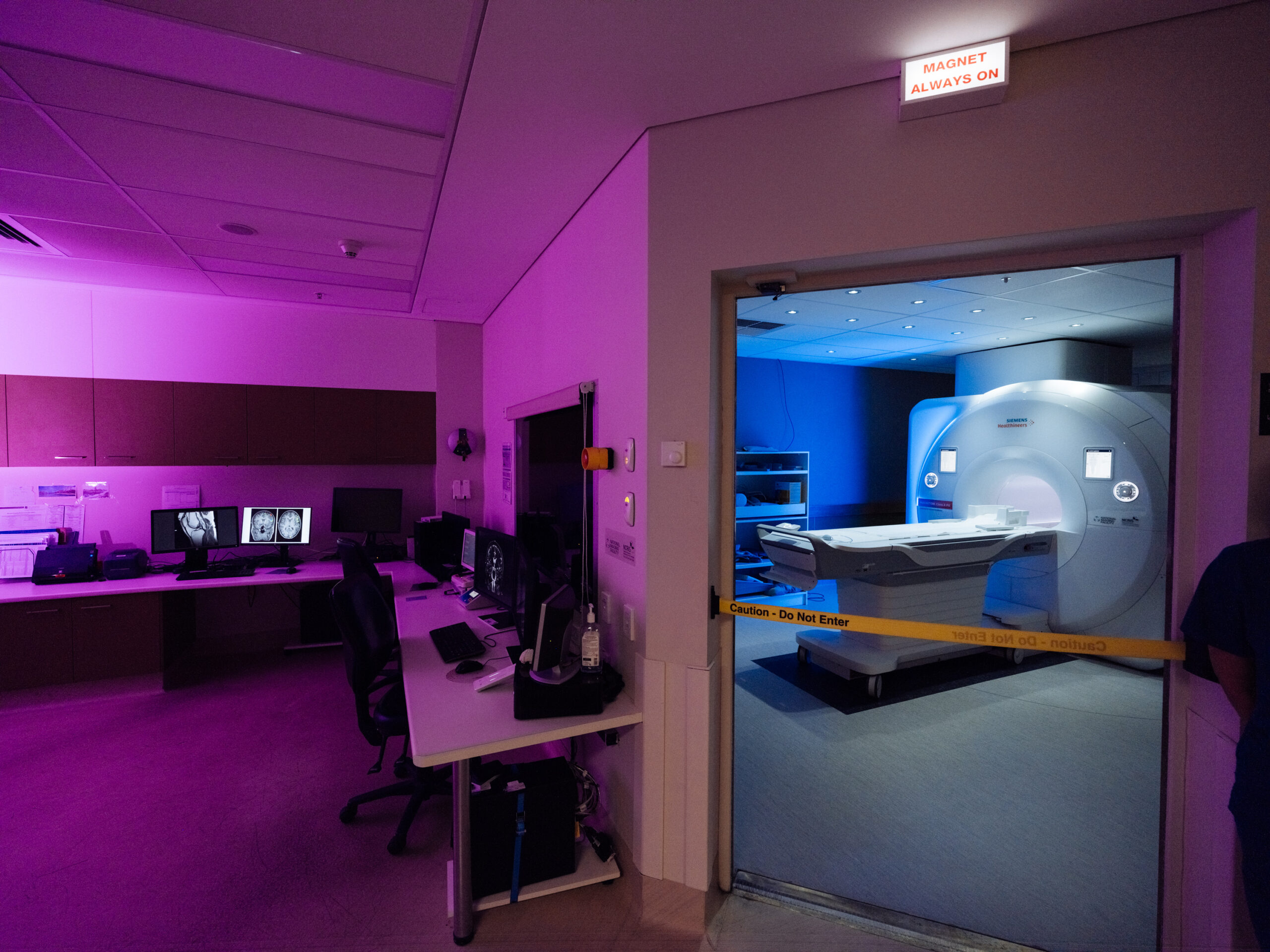
Queenslanders will benefit from faster, sharper and more precise medical imaging with the launch of one of the world’s most advanced MRI scanners at the Herston Imaging Research Facility (HIRF) in Brisbane.
The Siemens Healthineers MAGNETOM Cima.X 3T MRI scanner, significantly enhances Queensland’s advanced imaging capability and further strengthens Australia’s national research infrastructure.
The installation was supported through a collaborative investment of approximately $1.8 million from The University of Queensland, the Queensland Government and the National Imaging Facility via NCRIS funding.
The system delivers ultrahigh gradient strength – resulting in clearer images and faster acquisition – and intelligent adaptation to each patient’s breaths and heartrate during scanning.
“This lifts the ceiling on what we can see, measure and understand,” said Professor Paul Bonnington (Chair of the Executive Committee for HIRF and Pro-Vice-Chancellor of Research Infrastructure at UQ) of the new addition.
“For patients, that means quicker scans and greater comfort. For clinicians and researchers, it means earlier detection, better disease monitoring and higher quality data,” he said.
For doctors and scientists, said Prof Katie McMahon (Deputy Director and Academic Lead of HIRF), the new scanner brings advanced discoveries into everyday healthcare sooner: “It opens the door to earlier disease detection, better tracking of conditions like stroke, dementia, and cancer and faster progress in medical research.”
“HIRF is Australia’s first human imaging research facility entirely devoted to clinical research,” said Professor Deborah Terry AC (UQ Vice-Chancellor).

This is a great example of universities, government and industry coming together. No single organisation holds all the expertise, infrastructure, or insight needed to tackle today’s most complex health challenges, ranging from anxiety and post-traumatic stress disorder (PTSD), to motor neurone disease, Parkinson’s, multiple sclerosis and stroke.”
HIRF Director Professor Roslyn Francis said the scanner would be available to hospitals, health and research institutes and industry partners. “The ability to used advanced clinical scanners for research means translation impact occurs without overburdening the public systems,” she said.
The Cima.X also represents a major step forward for Australia’s imaging ecosystem: it is a powerful addition to the National Imaging Facility’s national network of advanced imaging instruments and expertise.
NIF connects researchers, clinicians and industry partners across 14 Partners, and numerous hospitals and medical research institutes.
By expanding access to cutting-edge imaging, HIRF and NIF are expected to accelerate translational research and strengthen Australia’s global competitiveness in medical science.